Every Power Rankings post so far has run on my own logged rounds. This one doesn’t. Game Caddie user, Joe Barrett, allowed me to create Career and Last 10 Power Rankings — same formula, same methodology, using his recorded rounds. As I discuss below, his dataset is much better suited to a Career vs. Last 10 analysis than mine.
In this post I am only going to look at the Men’s Power Rankings. Joe only has 9 LPGA players with a minimum of 3 rounds — not enough to make any comparisons meaningful.
A dataset with a very different shape
Barrett’s men’s pool has 41 golfer-season cards, against the 506 in mine — but “smaller” undersells how differently it’s built. My dataset is broad and shallow: hundreds of golfers, most with well under ten rounds logged for any one card. Barrett’s is narrow and, in a handful of cases, extremely deep.
Four cards alone account for just over half his total rounds: Tiger Woods’s 2000 card (132 rounds), Jack Nicklaus’s 1975 card (126), Bobby Jones, Jr.’s 1930 card (112), and Arnold Palmer’s 1960 card (110). Scottie Scheffler shows up four separate times (2022 through 2025) with round counts from 31 to 60. The other 33 cards in his set sit right at or near the 4-round qualifying minimum.
That split — a few workhorse cards played over and over, and a long tail played just enough to qualify — is exactly the kind of data set that makes comparing Career and Last 10 interesting, because the two rankings can only diverge on a card where there’s more than 10 rounds to choose from. In my dataset, only 5 of 506 cards clear that bar. In Barrett’s, 14 of 41 do — better than 1 in 3.
The two Top 10s
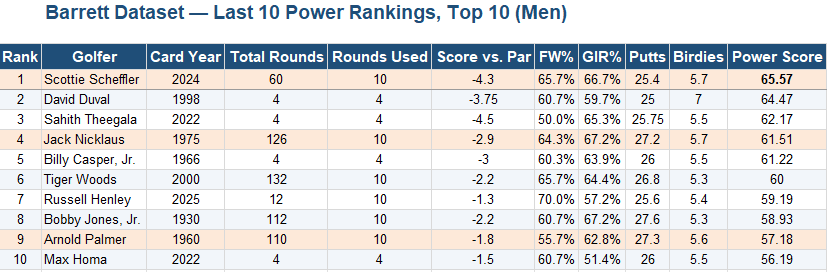
There are immediately noticeable differences between Joe’s Top 10 Career Power Rankings and his Last 10. Just looking at the Top 10s, we see shifts in ranking as well as one marquee swap: Scottie Scheffler’s 2025 card, positioned 9th on the Career Power Rankings, is replaced by Arnold Palmer’s 1960 card on the Last 10 list. Both Top 10 lists are shown below:
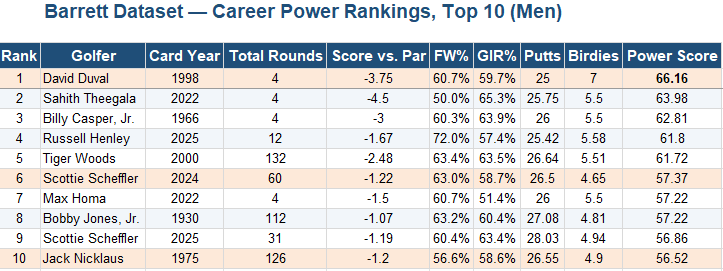
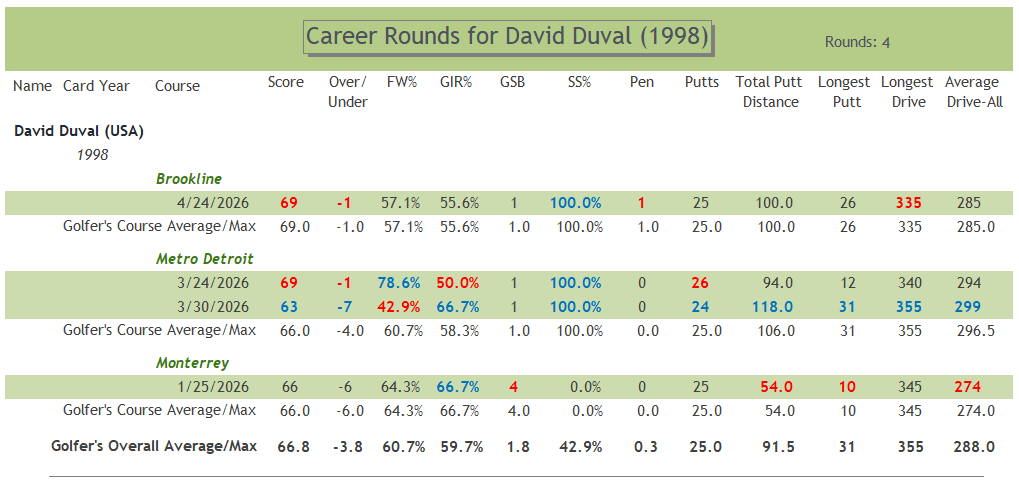
David Duval’s 1998 card tops the Career list, albeit with only four rounds. Two of those rounds are 7-under at Metro Detroit (Oakland Hills) and 6-under at Monterrey (Cypress Point). The other two rounds are both 1-under at Brookline (The Country Club) and Metro Detroit. Here’s what those rounds look like:
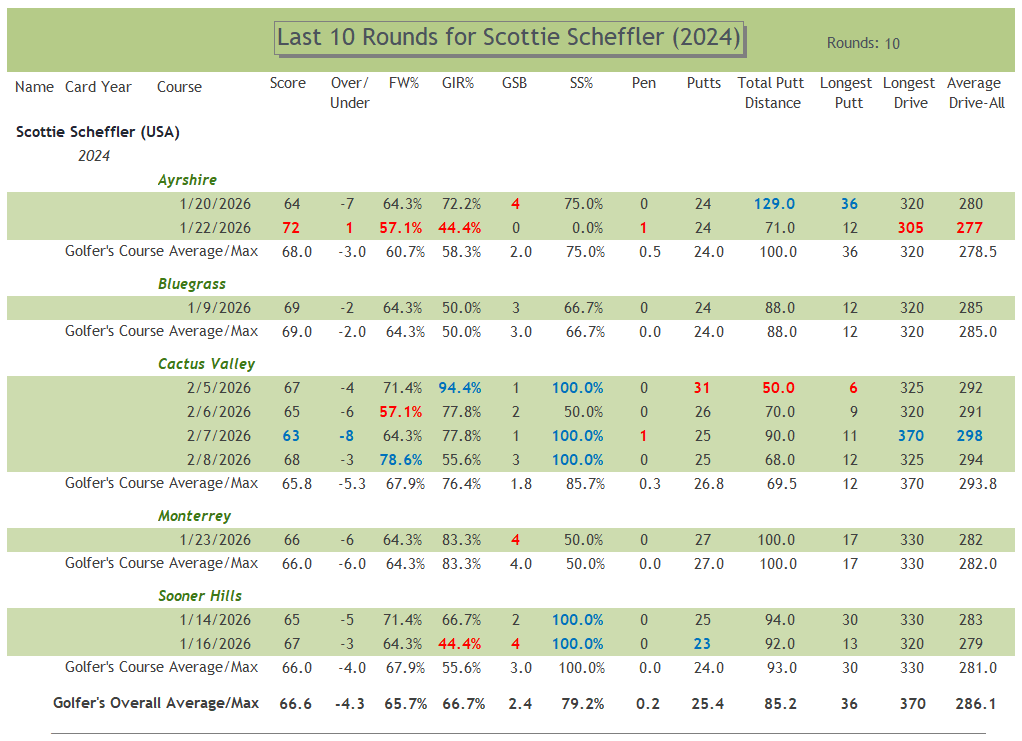
However, Scottie Scheffler’s 2024 card — 6th on the Career list — leaps all the way to 1st on the Last 10 list. His scores range from 8-under at Cactus Valley (TPC Scottsdale) to 1-over par at Ayrshire (Royal Troon). Here are those 10 rounds:
Jack Nicklaus’s 1975 card climbs from the 10th spot on the Career Top 10 to no. 4 on the Last 10 list. Meanwhile, Arnold Palmer’s 1960 card jumps from 18th on the overall Career Rankings to 9th on the Last 10 list.
How much do the two rankings actually agree overall?
Quite a bit, on the whole. Career and Last 10 Power Scores across Barrett’s 41 cards correlate at 0.96 — a golfer who ranks well on one list is, in almost every case, going to rank well on the other. But “almost every case” is where it gets interesting.
The biggest movers
Scottie Scheffler’s 2024 card is the single biggest riser in the data set — 57.4 on the Career list, 65.6 on Last 10, a gain of 8.2 points, enough to jump from very good to great. Nicklaus’s 1975 card gains 5.0 points, Palmer’s 1960 card gains 4.7, and Rory McIlroy’s 2023 card gains 4.1 — all four of the biggest career-to-recent-form jumps come from cards with 20 or more total rounds, which makes sense: those are the only cards with enough depth for a 10-round recent window to look meaningfully different from a full-career average.
Scheffler also owns the other end of the list: his 2025 card falls 5.8 points from Career to Last 10, the largest drop of any card in the set. Russell Henley’s 2025 card falls 2.6, and Tiger Woods’s 2000 card, Sahith Theegala’s 2022 card, and David Duval’s 1998 card all slip a bit as well. Here is the complete ranked list of every card’s Career-to-Last-10 swing:
Not every score change means a round changed
Here’s the detail that makes this data set a useful teaching example. Twenty-seven of Barrett’s 41 cards — the ones with 10 or fewer total rounds — feed the exact same rounds into both the Career and Last 10 formulas. Nothing about those golfers’ underlying performance is different between the two sets. And yet several of them still post different Power Scores.
David Duval’s 1998 card is the cleanest example. His line is identical in both sets — a -3.75 scoring average, 60.7% fairways, 59.7% greens, 25.0 putts, 7.0 birdies per round — but his Career Power Score is 66.16 and his Last 10 Power Score is 64.47, a 1.7-point gap with zero difference in his own rounds. Sahith Theegala and Billy Casper, Jr. show the same pattern.
The explanation isn’t a bug — it’s what the z-score methodology is supposed to do. A Power Score isn’t a grade against a fixed standard; it’s a measure of how far a card sits from the average card in its own pool. When Woods, Nicklaus, Jones, Palmer, and the four Scheffler seasons get winnowed down to their 10 most recent rounds for the Last 10 calculation, the whole pool’s average shifts — in this case, the pool’s average scoring, fairway, and green numbers all move slightly — and every other card’s z-score shifts with it, even the ones whose own rounds never changed. A fixed performance can look slightly better or slightly worse depending entirely on what the rest of the field just did.
A quick cross-check against my own numbers
A few of Barrett’s cards match cards in my own Last 10 rankings, and it’s worth a glance at how differently the “same” card can score depending on whose rounds — and whose dice — are behind it.
My Last 10 numbers have Woods’s 2000 card at 62.8 and Palmer’s 1960 card at 63.7; Barrett’s have them at 60.0 and 57.2. Scheffler’s 2024 card sits at 68.6 in my rankings and 65.6 in Barrett’s. Nicklaus’s 1975 card is the outlier — 61.5 in both data sets, close enough to be a coincidence rather than a pattern. None of this means one data set is “right” — it’s a reminder that a Power Score is a function of the rounds that produced it and the pool it’s measured against, and two people playing the same card can walk away with two honestly different pictures of how good it is.
Caveats
Barrett’s Career and Last 10 pools are small enough — 41 cards apiece — that individual results carry more noise than the 506-card men’s rankings I posted about. A handful of cards near the 4-round minimum are especially sensitive to one unusual round. And because his pool’s shape is so different from mine (a few very deep cards, many very shallow ones), his pool averages and standard deviations aren’t the same as mine — which is exactly why a card appearing in both data sets doesn’t score identically in each. Treat the comparisons above as illustrative, not as a verdict on any golfer’s card.
Thanks, Joe
The real value here is that Barrett’s rounds are entirely independent of mine — different dice, different sessions, different pool of cards, different Game Caddie settings in some cases, no overlap in the data that produced them. That’s what makes the comparison worth anything. When I run Career against Last 10 inside my own dataset, I have no way of knowing how much of the result is the formula and how much is just me: my tendencies, my luck, the particular mix of cards I happen to play.
A second, unrelated dataset is the only real check on that. And the check came back encouraging — at a high level, the two sets tell the same story, which suggests the methodology is measuring something real rather than something about my rounds. Where they diverge on individual cards, that’s informative too: it puts a rough size on how much a Power Score depends on whose rounds are behind it.
My prediction for what happens as we both keep logging: the two datasets should agree more, not less. Most of the gap between them right now is thin numbers of rounds and unstable pool averages, and both of those problems fix themselves with volume. As more cards clear the 4-round minimum and then the 10-round mark, each pool’s averages and standard deviations should settle down, and a card’s Power Score should stop moving just because the field around it moved.
I’d expect the Career numbers to converge first and hold steady — that’s a full-career average, and it gets harder to budge with every round added. Last 10 should stay the lively list in both sets, because it’s designed to be: 10 rounds is a small enough window that a hot or cold stretch will always show up there. The interesting test a year from now won’t be whether Barrett’s numbers match mine. It’ll be whether the cards that diverge between Career and Last 10 are the same cards in both data sets — because if they are, that divergence is telling us something about the card, not about the golfer rolling the dice.
Joe Barrett’s combined Career and Last 10 Power Rankings can be viewed by clicking on the PDF below: