Tournament action for this replay began exactly four months ago on April 19, 2026. During that time I logged 252 rounds on Steel City (Oakmont), many of them fruitless efforts to break par. This post covers the results of Round 4 for both the actual event and the replay along with a wrap-up.
See my previous posts for details on the setup and the first three rounds. For my last post in the series, I’ll tackle the question of how well Steel City represented Oakmont in a Major competition?
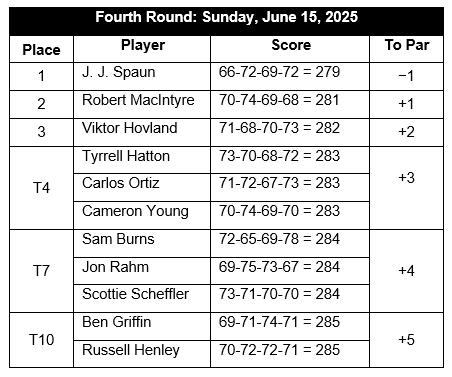
Round 4 Actual Results: Oakmont Conquered All but Spaun
Saturday left the championship exactly where Oakmont wanted it. Sam Burns held a one-shot lead over Adam Scott and J.J. Spaun, with Viktor Hovland three shots back. Several others remained close enough to make a Sunday charge.
Then Oakmont (par 70) started taking contenders away. Burns had controlled the championship since his second-round 65, but Sunday finally caught him. A closing 78 turned a one-shot lead into a tie for seventh at four over.
Scott suffered an even harder fall. After playing his way into the final pairing with a Saturday 67, he closed with a 79 and dropped from a share of second to a tie for twelfth. Two of the three players who began Sunday at the top of the leaderboard had disappeared from contention.
Others tried to come from behind. Jon Rahm and Rory McIlroy produced the low rounds of the day with matching 67s. Rahm climbed into a tie for seventh and McIlroy into a tie for nineteenth, while Xander Schauffele and Ryan Fox shot 69s and also made significant moves up the leaderboard. All had simply started Sunday too far back to threaten the championship.
Viktor Hovland stayed in the fight longer than most. His closing 73 left him third at two over, while Cameron Young shot 70 to join Tyrrell Hatton and Carlos Ortiz in a tie for fourth at three over. Scottie Scheffler’s second consecutive 70 moved him into a tie for seventh.
Robert MacIntyre was different. Starting Sunday six shots behind Burns and five behind Spaun, he closed with a 68 and posted one over in the clubhouse. His charge from a tie for ninth suddenly gave Spaun a number he still had to beat.
Spaun answered. A birdie on the 17th moved him to even par and gave him a one-shot lead heading to the final hole. MacIntyre still had a path to a playoff if Spaun stumbled, but Spaun made sure that never became an issue.
Facing a 64-foot birdie putt on the 18th green, Spaun rolled it in. The birdie moved him to one under, turned a one-shot advantage into a two-shot victory, and left him as the only player to finish the championship below par. After four days of Oakmont refusing to let anyone get comfortable, Spaun ended the championship with its defining shot.
It was a fitting finish to a four-day journey that began with his opening-round 66. Spaun led after Thursday, surrendered the lead Friday, and stayed one shot behind Burns entering Sunday. While the leaderboard changed around him, Spaun never went away.
The final-round scoring reflected the struggle. After averaging 71.9, 72.3 and 72.7 over the first three rounds, the qualifiers averaged 73.2 on Sunday. Oakmont saved its toughest test for last.
Saturday had compressed the leaderboard and given a long list of players a chance. Sunday closed the door one contender at a time. Burns went backward, Scott disappeared, Hovland held on, and MacIntyre charged from behind and made Spaun finish the job.
Spaun did not overpower Oakmont. He survived it better than everyone else, then rolled in one final birdie from 64 feet to put an exclamation point on the victory. After four days at Oakmont, that seemed a fitting way to win the U.S. Open. The final round Top Ten leaderboard is provided below.
Round 4 Replay Results: Scheffler, Morikawa Conquered Steel City
Sunday was difficult at Steel City (par 70) as well. The scoring average climbed to 72.3, the highest of the four rounds. Unlike Oakmont, however, the difficulty never reached the two players at the top.
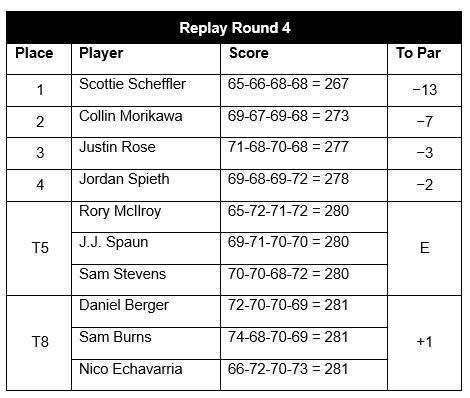
Scottie Scheffler entered the final round with a six-shot lead over Collin Morikawa and seven over Jordan Spieth. There would be no opening for a Sunday charge. Scheffler closed with a 68 to finish at 13 under, completing four rounds without shooting higher than 68.
Morikawa was nearly as steady. His closing 68 moved him to seven under and secured second place, six shots behind Scheffler. He finished the championship with four rounds of 69 or better and never gave anyone behind him much opportunity to move past him.
The separation that began earlier in the week was complete. Scheffler and Morikawa did not survive Steel City by waiting for everyone else to make mistakes. They continued to play exceptional golf while the challengers gradually fell further behind.
Justin Rose made Sunday’s best move near the top of the leaderboard. His 68 lifted him from a tie for seventh to third at three under. It was an excellent round, but Rose began Sunday ten shots behind Scheffler and finished ten shots behind him. His charge improved his position, but never changed the championship.
Jordan Spieth went the other direction. After beginning Sunday alone in third at four under, a closing 72 dropped him to fourth at two under. Rory McIlroy also shot 72 and finished at even par, tied for fifth with J.J. Spaun and Sam Stevens.
There were good rounds further down the leaderboard. Chris Gotterup posted the low round of the day with a 67, while Daniel Berger, Keegan Bradley, Sam Burns, Laurie Canter, Jason Day, Tommy Fleetwood, Rasmus Højgaard, Min Woo Lee, and Justin Thomas shot 69. Like Rose, they improved their position but had little impact on the championship.
Spaun provided an interesting connection between the two tournaments. The actual U.S. Open champion finished the replay at even par, good for a tie for fifth. It was a strong week at Steel City, but still left him 13 shots behind Scheffler.
Nothing similar to the drama at Oakmont developed at Steel City. Scheffler and Morikawa started first and second, both shot 68, and finished first and second. While Steel City became more difficult and the players behind them fought for position, neither leader gave anyone an opening.
Sunday at Oakmont became a battle of survival, and Spaun was the last contender standing. At Steel City, there was no such battle. Scheffler and Morikawa had gradually separated from the field over four rounds, and simply finished the job on Sunday. The replay top ten leaderboard is provided below.
Round 4 Replay Highlights and Lowlights
The final round produced plenty of fireworks even though the championship itself never became close. Tom Hoge eagled the 4th, Ryan Gerard eagled the 2nd, Joaquín Niemann eagled the 12th, and Viktor Hovland eagled the 11th. Harris English supplied the longest putt of the day, rolling in a 50-footer on the 8th.
Steel City also delivered one final collection of painful moments. Jon Rahm four-putted the 13th from only eight feet, while Hoge followed his earlier eagle with a four-putt from 12 feet on the same green. Bryson DeChambeau missed a one-foot putt on the 8th, and Akshay Bhatia suffered the same fate on the 18th.
Hoge’s round may have captured Steel City better than any other. He soared with an eagle, then fell to earth with a four-putt. Even on Sunday, the course remained capable of giving something away and taking it right back.
Round Four by the Numbers
- Sungjae Im hit 12 of 14 fairways. (Avg. = 7.4)
- Brian Campbell hit the fewest fairways with 3 of 14.
- Daniel Berger, Sam Burns, Ryan Gerard, Rasmus Højgaard and Joaquín Niemann each hit 15 of 18 greens in regulation. (Avg. = 11.3)
- Brian Campbell hit the fewest greens with 6.
- Ludvig Åberg and Chris Gotterup led all players in average driving distance on the designated driving holes at 343 yards. (Avg. = 297)
- Rasmus Højgaard and Rory McIlroy led all players in average driving distance on all drives at 311 yards. (Avg. = 294)
- Ryan Fox and Adam Schenk had the longest drives at 390 yards.
- Harris English sank the longest putt at 50 feet.
- Corey Conners led all players with 129 feet of putts made. (Avg. = 77.1)
- Keegan Bradley, Harris English, Tommy Fleetwood, Collin Morikawa and Justin Thomas took the fewest putts with 28. (Avg. = 31.7)
- Joe Highsmith took the most putts with 38.
Wrapping Up the Replay
Four rounds at Steel City produced a U.S. Open that looked familiar in many ways but not in all of them. The course punished missed greens, produced plenty of difficult recovery shots, and made putting an adventure. There were eagles and long putts that went in, but also four-putts, missed short putts, an abundance of buried lies, and rounds that could unravel quickly.
What it did not produce was the same leaderboard pattern as Oakmont. The actual championship compressed the field as the week progressed. In the replay, the scoring averages remained relatively stable while the best players increasingly separated themselves from the field. By Sunday, Scottie Scheffler had turned that separation into a runaway victory.
That difference raises the more interesting question behind the replay. How well did Steel City actually represent Oakmont?
The answer should not come from the final score alone. We now have four rounds of replay data and the corresponding statistics from the actual 2025 U.S. Open. That allows us to compare overall scoring, scoring distribution, fairways and greens, putting, driving, and the way the course rewarded good play and punished mistakes.
In my next post, I will put those numbers side by side. The objective is not to determine whether Steel City reproduced the 2025 U.S. Open shot for shot. It obviously did not. The better test is whether it reproduced the character of Oakmont and whether the differences tell us something useful about the course representation itself.
That is where I think this replay gets particularly interesting.
The entire set of tournament replay results can be viewed by clicking the upper righthand corner of the PDF below: