Steel City gets the math right. That is the most important conclusion from my replay of the 2025 U.S. Open at Oakmont.
Played with APBA Golf’s Master Game rules, the course designer’s special instructions and Game Caddie’s “Modern” distance setting, Steel City produced a remarkably convincing statistical representation of one of the most difficult championships in golf. The actual qualifiers averaged 72.5 shots per round. My 63-player replay field averaged 72.0.
The similarities went well beyond the final score. Driving distance was almost identical, penalty strokes were almost nonexistent in both events, and the differences in fairways, greens in regulation, bunker play, and putting give us a much richer picture of how Steel City performed.
Getting there, however, required a lot of painstaking effort. Steel City modifies lies, carry and roll, restricts clubs, changes bunker outcomes, and makes position on the green matter. Individual holes and pin locations can add still more instructions.
None of those features is particularly difficult by itself. Collectively, they ask a lot of the APBA player, particularly over a four-round replay involving 63 golfers and roughly 18,000 shots. So this review ultimately comes down to two questions. Did all that additional exertion make Steel City behave like Oakmont? The numbers say it did.
The second question is harder. Did it make Steel City fun to play?
The Designer’s Dilemma
Before criticizing the solution, it is worth appreciating the problem. Oakmont is an unusual golf course to reproduce in a board game.
The 2025 U.S. Open setup measured 7,372 yards, substantial but hardly extraordinary by modern major-championship standards. Oakmont’s rated Championship tees are 7,427 yards with a USGA Course Rating of 77.6 and Slope of 143, extraordinary numbers for a par-70 course.
Yet the reasons for that difficulty are not immediately obvious on a game board. There are relatively few trees, water is not a major defense, and out of bounds generally sits well away from normal play.
Oakmont doesn’t need an ocean to swallow golf balls. It doesn’t need trees lining every fairway or water waiting beside every green. Its defenses are different. Fairway position matters. The rough matters. Bunkers matter. Most of all, approach position matters on some of the fastest and most severely contoured greens in championship golf.
Those greens are also large. That sounds like an advantage until a player discovers that hitting an Oakmont green and hitting the right part of an Oakmont green can be two very different accomplishments.
That creates a problem for APBA Golf. A board game is very good at modeling discrete consequences. Hit it into water and take a penalty. Find a tree and deal with the obstruction. Land in a bunker and play from sand.
Oakmont can punish a perfectly playable golf shot simply because it finished in the wrong place. Steel City’s designer had to find a way to put that on a board.
Steel City in Some Tough Company
Steel City makes more sense when placed beside three other difficult championship courses I have replayed. Seaside (pebble Beach), Sooner Hills (Southern Hills), and Acorn Hill (Oak Hill) are all serious tests, but they get there in very different ways.
The first comparison is about the golf courses themselves. Championship yardage shows what the professionals faced, while Course Rating and Slope provide an independent measure of the underlying course’s difficulty.
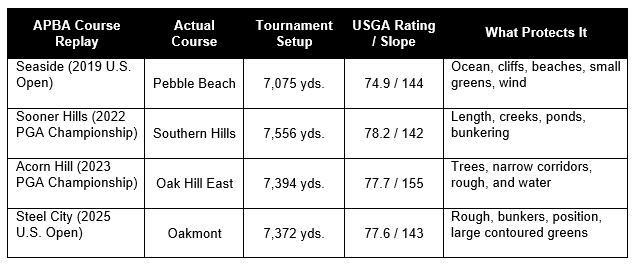
The numbers do not always come from precisely the same sets of tees as the temporary tournament setup. That is not a problem for what we are doing here. The tournament yardage tells us what the professionals faced, while Rating and Slope give us a common measure of the underlying golf course.
The table makes the designer’s problem easier to see. Seaside has the Pacific Ocean, cliffs, beaches, small greens, and wind. Sooner Hills has length and plenty of water and creeks. Acorn Hill combines trees, narrow corridors, rough (with a max 7-iron restriction), and water.
All three give a game designer obvious ways to make a golfer pay for a bad shot. Steel City is different. Its USGA numbers say Oakmont belongs comfortably in this company. But there is no Pacific waiting for a wild drive, no forest framing the course, and little water threatening shot after shot.
So, what protects Steel City? That is the designer’s dilemma. It is also the reason the Master Game rules and Steel City’s special instructions become so important.
What Happened in the Replays?
The table below asks a different question. Regardless of how these golf courses create their difficulty, how closely did their APBA versions reproduce the actual championships?
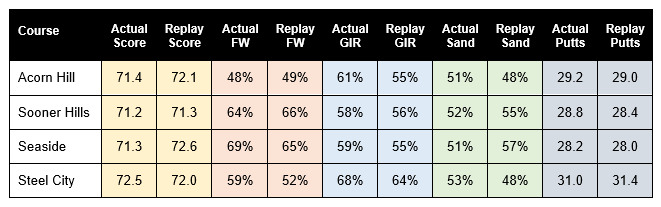
Acorn Hill finished 0.7 strokes harder on average in the replay than for the actual qualifiers. Its fairway percentage was almost exact, 49% versus 48%, while putting was 29.0 versus 29.2 per round. GIR was lower, but the overall statistical profile looked reasonably like the tournament it was intended to reproduce.
Sooner Hills was closer still. Replay scoring averaged 71.3 versus 71.2 actual, with fairways at 66% versus 64%, GIR at 56% versus 58%, and putting at 28.4 versus 28.8.
Seaside was the clear scoring outlier. Its replay averaged 72.6 against 71.3 actual, a difference of 1.3 strokes. Seaside also averaged 1.1 penalties per replay round. That is worth remembering because Pebble Beach has obvious places for a golf ball to find serious trouble, while Oakmont generally does not.
There was another factor at Seaside. I had followed APBA’s course “J” wind rating, which typically produces Blustery conditions, but the actual 2019 U.S. Open did not experience four days of anything comparable. The actual winds were generally modest, ranging from roughly 5 to 14 mph, with only occasional higher gusts. The Blustery replay setting therefore gave Seaside a weapon the real Pebble Beach did not consistently have that week.
That replay changed the way I set up tournaments. After Seaside, I began researching the actual tournament weather and selecting replay conditions representative of what the professionals really encountered.
Acorn Hill was played under Normal, Normal, Soft and Normal course conditions with Calm winds throughout. Sooner Hills went from Firm to Dry to Soft to Normal with Moderate winds, while Steel City was played under Normal course conditions with Calm winds each round.
Oakmont carries a “B” wind rating and, as such, typically plays as Calm. The replay used Calm winds as well because that aligned with the conditions during the actual tournament. Steel City’s difficulty therefore was not manufactured by dialing up the weather.
The four replays give us useful context. Seaside has the ocean, cliffs, beaches and wind. Sooner Hills has length and water. Acorn Hill has length, rough and trees.
Steel City does share one important defense with Acorn Hill: difficult rough. But the two courses are modeled differently.
At Acorn Hill, a ball in the rough is limited to a 7-iron with a 6-line drop on the lie dice roll (e.g., a roll of 21 becomes a 31) that increases the chance of drawing a buried lie. At Steel City, the club restriction is less severe, with a maximum 3-iron allowed, but the lie is prescribed as automatically buried.
That distinction matters. Acorn Hill makes a bad lie more likely; Steel City makes it a certainty. The 3-iron allowance partly compensates for that punishment, but it also illustrates a tradeoff we will see repeatedly at Steel City: The rules can produce the desired difficulty while sometimes sacrificing the more realistic variability that occurs in actual golf.
And rough alone cannot explain Oakmont. Seaside still has its ocean and cliffs, Sooner Hills its water, and Acorn Hill its trees and narrow corridors. Steel City had to find other ways to make position itself the hazard.
Did Steel City Get Oakmont Right?
The short answer is yes. The more interesting answer is that Steel City did not always get there the same way Oakmont did.
APBA produces only about 80 men’s player cards for each season, while major-championship fields are much larger. My replay used the 63 APBA-carded players who actually competed at Oakmont, and all 63 played four replay rounds.
The replay field and actual comparison population therefore are not identical. APBA generally cards accomplished players rather than the weaker end of a major field, and its ratings are based on season-long performance.
A major-championship cut is a different selection process, but it also leaves a strong field. The annual scoring averages on which APBA’s ratings are based are very close to those of a typical major-championship field, so the two groups provide a reasonable basis for aggregate comparison.
This is not a double-blind experiment, and it doesn’t need to be. With 63 replay golfers producing 252 rounds and roughly 18,000 shots, there is plenty of golf from which to identify broad patterns. Nobody is submitting this to The Journal of Applied Dice Rolling. The objective is simply to make the comparison disciplined enough that when something differs, there is a reasonable basis for asking why.
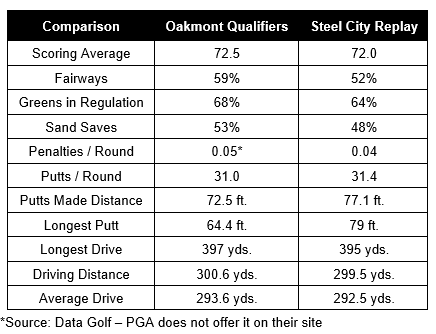
Actual tournament statistics are primarily from the PGA tournament portal, with ESPN used occasionally for supplemental hole statistics and cross-checking. Replay statistics come from the Game Caddie Record Book.
The penalty number is revealing precisely because it is so small. Steel City did not manufacture a two-over-par golf course by sending balls into water or out of bounds, and neither did Oakmont.
Compare that with Seaside’s 1.1 replay penalties per round. Pebble Beach has cliffs, beaches, and an ocean available to turn a bad swing into an immediate number on the scorecard. Steel City had to extract its strokes somewhere else.
Driving provides another useful validation of the setup. Before the replay, I found that actual U.S. Open driving distances were close to contemporary annual Tour averages, suggesting that Game Caddie’s “Modern” distance setting should reproduce them reasonably well.
It did. The replay’s 299.5-yard Driving Distance (two holes) was almost identical to the actual 300.6, while Average Drive (all non-par 3s) finished at 292.5 versus 293.6.
That matters because it removes one easy explanation for the scoring. Steel City wasn’t difficult because the replay golfers were artificially short off the tee. (It is worth noting that hole lengths were adjusted for the replay to more closely match actual tournament distances.)
The more interesting differences begin after that. The replay hit substantially fewer fairways, 52% versus 59%, and fewer greens, 64% versus 68%.
Sand saves were also harder to come by, 48% versus 53%, while the replay required 31.4 putts per round compared with 31.0 actual.
To recap: The replay players hit fewer fairways and greens, were less successful from the sand, and still took about 0.4 more putts per round. Yet the actual players averaged about half a stroke more overall, meaning they took more strokes getting to the green. Where those additional strokes occurred, the available data cannot tell us.
That is as far as the numbers take us. Anything more would be guessing.
Four Rounds, Four Setups
The overall 72.0 hides another useful result. Steel City’s scoring remained remarkably stable through four different setups.
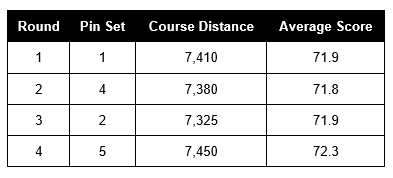
The course was not simply replayed four times from the same setup. Different pin sets changed individual hole distances and, in some cases, carry requirements and how particular shots played.
Yet the scoring moved only half a stroke from the easiest to the hardest round. That suggests Steel City’s difficulty was structural rather than dependent upon one especially punitive pin set or yardage.
How Steel City Does It
The Master Game rules and Steel City’s terrain and course notes attack the Oakmont problem from several directions. Rough becomes more costly, fairway bunkers receive harsher treatment, carry and roll adjustments alter effective playing distance, and some holes impose consequences based not merely on whether a shot hits the green but where it finishes.
Some of these devices are easier to accept as golf simulation than others. Treating every Regular Rough (RR) lie as buried is effective, but real rough does not produce the same lie every time.
Allowing as much as a 3-iron from that universally buried lie creates another compromise. Likewise, making every Fairway Bunker (FB) lie “poor” guarantees a challenge, but a look at Oakmont’s bunkers hardly suggests that every ball entering one must inevitably draw a terrible lie.
Those are contrivances, but that word should not end the discussion. Every board game is built from abstractions, and the useful question is what those maneuvers accomplish. There is an important distinction here between statistical accuracy and golf fidelity. A mechanism can produce the right number without necessarily reproducing the way real golfers arrive at that number.
At its best, Steel City does both. At other times, it sacrifices some golf realism to obtain the statistical outcome it seeks. Hole no. 9 provides an unusually good example of Steel City at its best.
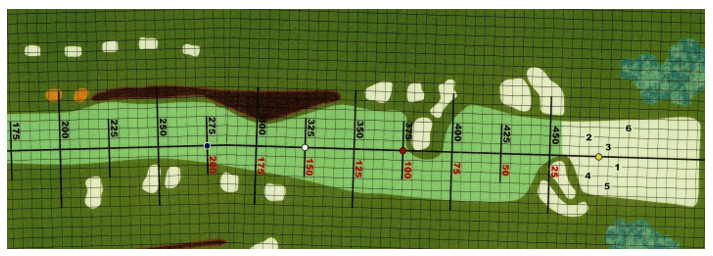
No. 9 presents problems from right off the tee. A large, brown ditch extends into an already narrowing fairway around the driving area, forcing the player to decide how much of it to challenge. Landing or rolling into the ditch results in an automatic buried lie with a PW-club restriction.
Laying back reduces the immediate risk but leaves a longer second shot. That would be the conventional golf decision except for what waits at the other end.
The large green initially appears to offer a generous target. The designer, however, placed all of the pin positions toward the front portion of that green. The extra depth isn’t necessarily your friend in this case. A longer approach brings greater dispersion, and a shot can safely find the large green yet finish well above the flag.
Steel City then supplies a course note consequence that the ABPA rendering doesn’t convey on its own. Finish above the hole and the first putt becomes three columns longer by rule, turning a GIR into a potentially expensive result. The course designer’s method of making this hole more difficult may be artificial, but the golf problem it is trying to address is very real.
No. 9 was the hardest hole in the actual championship, averaging about 4.52 strokes, or +0.52 to par. In my Steel City replay, it averaged approximately 4.47 strokes, or +0.47.
That is an extraordinarily close result. The designer made the terrain impose a strategic choice from the tee and then used a putting adjustment to reproduce the consequence of leaving an approach in the wrong portion of an Oakmont green.
No. 18, the second toughest hole in the replay, uses a variation of the same idea and also played very difficult. No. 9 makes the point well enough without taking another exit off the highway.
The Price of Getting It Right
No. 9 represents Steel City at its best because the additional rules affect strategy. The player sees the danger, makes a decision and then lives with the consequence.
Not every Steel City course note works the same way. Some simply impose a consequence after a particular result (e.g., shots in the RR roll no more than 5 yards on every hole, except hole no. 17 where shots in the IR or RR roll no more than 10 yards). Individually, none is particularly burdensome.
Collectively, however, they change the rhythm of the game. Check the carry adjustment. Check the roll. Check the lie. Check the bunker rule. Check the landing position. Check the hole number. Check whether the hole and pin combination adds another instruction.
Putting was not where most of that administrative burden occurred. Despite some unusual positional rules such as those on No. 9, putting itself was generally straightforward. The human-player workload comes primarily before the ball reaches the green. A 72.0 scoring average minus 31.4 putts leaves about 40.6 non-putting shots per player per round.
Multiply that by 63 players and four rounds and the scale becomes clearer. The replay contained roughly 10,200 drives, woods, irons, approaches, bunker shots and other non-putting shots.
Those are precisely the shots where Steel City’s buried lies, club restrictions, carry adjustments, roll rules, bunker instructions, and other special provisions often come into play. That is a lot of opportunities to consult another rule.
Game Caddie automated and simplified much of that work. I cannot imagine attempting a replay of this size (or even more than a few rounds) without it. Even with that assistance, I found the full Steel City rule set demanding over four rounds. Manually checking all of those instructions across thousands of non-putting shots would have been a very different undertaking. I’m sure I would have skipped (by accident) some each round.
There is an important qualification, however. My replay tested Steel City at something approaching industrial scale. A player taking a foursome around Steel City for an afternoon is not processing 10,200 non-putting shots. What became burdensome across a 63-player U.S. Open replay may be perfectly enjoyable over 18 holes with one or two golfers.
That distinction matters when judging the course fairly. Some APBA players enjoy digging deeply into course-specific rules and want every possible characteristic of Oakmont reflected in the result. For them, the rules are not overhead. They are part of the attraction. I am not one of them.
For others, APBA Golf is most enjoyable when the player cards, boards, shot choices, and dice carry most of the action. When special instructions begin determining too many outcomes, greater statistical accuracy can come at the expense of the experience that made the game enjoyable in the first place. That is not a statistical matter. It is a question about why each of us sits down to play a board game.
So, Should You Play Steel City?
Steel City gets the math about right. Given the design problems Oakmont presents, that is an impressive accomplishment. The designer had to make a relatively open golf course with large greens behave like one of the most difficult championship venues in the world. The Master Game rules and Steel City additions found a way to do it without relying on excessive penalty strokes, unrealistic wind conditions, or simply making the course extraordinarily long.
The question is what kind of APBA golfer you are. If you enjoy detailed course rules, positional consequences, and checking exactly where each shot finishes, play Steel City with the full Master Game rules and designer’s additions. The evidence says they work from a statistical standpoint.
If all that checking sounds more like work than recreation, play the Basic game and ignore the hole notes, or choose another course. A board game does not become better merely because it can make you work harder.
Neither choice is wrong. The statistics can tell us whether Steel City behaves like Oakmont, but they cannot tell us whether the experience required to make that happen is what any particular player wants from APBA Golf.
After all the Course Ratings, Slope Ratings, weather research, PGA statistics, penalty data, spreadsheets, and roughly 18,000 shots, there remains one statistic I cannot calculate: How much fun you had rolling the dice.
Hi Scott. I have played Oakmont twice in my life (real life, it’s 20 minutes from me) and APBA does nail the difficulty, they probably could have made the putting even more difficult. In real life , Tee to Green, its not that hard from the regular tees, but the course is set up such that a missed shot is very penal with the bunkers everywhere. #9 has all the holes in front because the back part of #9 green is the practice putting area, and I can tell you it is pretty absurdly fast. There is a good YouTube video on this green I’ll post.https://youtu.be/1LDhbyZPl9M?si=Ju8lW_Qkj70St-go