This post details round 2 of my 2025 U.S. Open replay at Oakmont (Steel City). It compares the results of the actual tournament with my replay through the first two days of the event. See previous posts for descriptions of the replay setup and the results of round 1.
Actual Results for Round 2
Round 1 showed that Oakmont punished players after they reached the green. Round 2 reinforced the lesson. The scoring average climbed slightly as the course continued to challenge every part of a player’s game. The leaderboard tightened as contenders disappeared.
Thursday identified the contenders. Friday reduced the list. Players who looked comfortable one day suddenly found themselves fighting to hold position. Oakmont was beginning to reveal who could survive four rounds.
J.J. Spaun entered the day with a one-shot lead after his bogey-free 66. He could not match that performance, but an even-par 72 kept him near the top. His margin disappeared, but his position did not. At Oakmont, survival often matters more than brilliance.
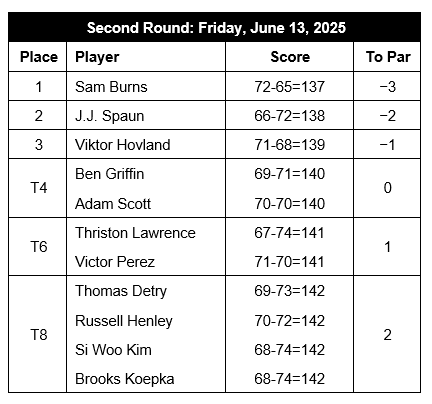
The biggest move belonged to Sam Burns. He opened the championship with a disappointing 72 and appeared headed in the wrong direction. Twenty-four hours later, he produced the round of the tournament. His five-under 65 vaulted him into the lead and gave him the only score below 66 through two rounds.
Burns stood out because almost nobody else solved the course. After 36 holes, only three players remained under par. Burns led at three under, Spaun followed at two under, and Viktor Hovland held third at one under. Everyone else was chasing.
Hovland may be the most interesting story on the board. Playing alongside Scottie Scheffler and Collin Morikawa, he chipped in for eagle at the drivable 17th and battled through several difficult stretches. More importantly, he stayed patient when Oakmont tested him. That discipline kept him firmly in contention heading into the weekend.
The human-interest stories extended beyond the leaders. Adam Scott quietly posted his second consecutive 70 and moved into a tie for fourth. At 44 years old and making his 96th consecutive major championship start, he proved that experience still matters. His steady play stood in sharp contrast to the chaos unfolding around him.
Ben Griffin shared fourth place after another solid round. While many established stars drifted backward, Griffin continued to look comfortable on one of golf’s toughest stages. He backed up his strong opening round and showed he belonged near the top of the leaderboard. Few expected to see his name there entering the week.
Victor Perez delivered Friday’s signature highlight. He recorded a hole-in-one on the sixth hole and still managed to card an eight elsewhere on the course. That scorecard captured Oakmont perfectly. One swing could create a highlight and the next could create a disaster.
The bigger story was who failed to separate. Thriston Lawrence followed his opening 67 with a 74, while Brooks Koepka, Si Woo Kim, and Thomas Detry all moved backward. The players who chased Spaun on Thursday struggled to maintain momentum. Oakmont refused to let anyone stay comfortable for long.
Many of the game’s biggest names spent Friday trying to reach the weekend. Scottie Scheffler, Rory McIlroy, Jon Rahm, and Jordan Spieth survived, but none managed to pull close to the lead. The course was not rewarding reputation. It was rewarding patience.
After 36 holes, Oakmont was no longer asking players to play great golf. It was asking them to endure. The weekend promised to be less about making birdies and more about avoiding mistakes. The field had already learned that lesson the hard way. The actual leaderboard for the top contenders in round 2 is provided below:
Replay Results for Round 2
Round 1 of the replay established that Steel City could reproduce Oakmont’s pressure. Round 2 revealed something different. While in the actual championship the leaders regressed toward par, the replay allowed the strongest players to keep or move below par. The course remained difficult, but a handful of players proved they could master it.
In the actual U.S. Open, the average score among eventual qualifiers rose from 71.9 in round 1 to 72.3 in round 2. The leaders compressed as Oakmont steadily pushed players backward. Sam Burns reached the halfway point at just three under par, and only three players remained under par.
The replay field faced the same challenge but produced a different outcome. The round 2 average score held virtually unchanged at 71.8 after a 71.9 opening round. Steel City remained demanding, yet the best players found ways to score while the rest of the field struggled to keep pace. The top 10 replay leaderboard follows:
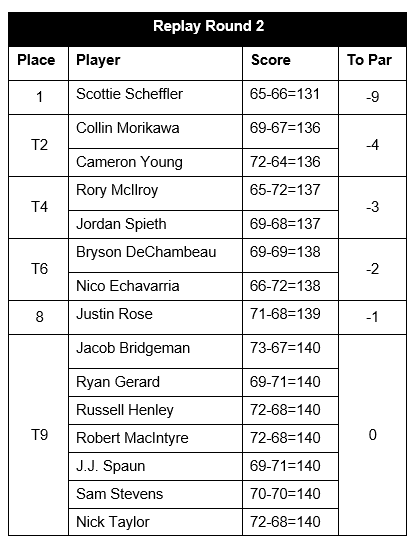
No player demonstrated that better than Scottie Scheffler. After sharing the first-round lead with Rory McIlroy, Scheffler followed his opening 65 with a second-round 66 and reached nine under par. At the halfway point, he holds a commanding five-shot lead over Collin Morikawa and Cameron Young.
Scheffler’s performance was built on complete control. Through two rounds he hit 30 of 36 greens in regulation, averaged fewer than 28.5 putts per round, and recorded only three bogeys. Steel City challenged everyone, but Scheffler never appeared to be fighting the course.
Morikawa quietly climbed into second place with a second-round 67. He hit 14 greens and continued to avoid major mistakes. While Scheffler strengthened his grip on the tournament, Morikawa has positioned himself as the closest pursuer.
Cameron Young delivered the round of the day. After opening with a 72 and sitting seven shots behind the leaders, Young fired a six-under 64 to climb into a share of second place at four under. No player improved his position more dramatically on Friday, and by day’s end he had turned a respectable start into a legitimate championship challenge.
Jordan Spieth also surged. After opening with a 69, he added a 68 and moved into a tie for fourth at three under. Bryson DeChambeau remained within striking distance as well, posting matching rounds of 69 to reach two under.
Several round 1 leaders could not maintain their position. Rory McIlroy began the day tied for the lead at five under but slipped back with an even-par 72. Nico Echavarria opened with a brilliant 66 but followed it with a two-over 72 and fell from third to a tie for sixth.
The fall was even steeper for others. Aaron Rai dropped from even par (T10) to four over after a 74 (T22). Joe Highsmith went from a tie for ninth after round 1 to nine over after a second-round 79 (T55). Thriston Lawrence, who had a respectable round 1 score of three over (T37), slid to ten over and barely survived the cut line (T60).
Replay Round 2 Analysis
The contrast between the actual championship and the replay could not have been clearer. Oakmont compressed the leaderboard and pulled contenders back toward par. Steel City remains every bit as demanding, but it has rewarded exceptional play. The course did not become easier in round 2. The best players simply handled it better than everyone else.
That may be the most important result of the replay so far. Steel City is producing pressure without forcing every score toward the middle. Players are still paying a price for mistakes, but elite rounds can still rise above the field. The leaderboard now reflects skill as much as survival.
After 36 holes, the replay no longer looks like anyone’s contest to claim. It looks like a championship beginning to belong to Scottie Scheffler.
Replay Highlights and Lowlights
The highlight reel for round 2 features some outstanding moments. Joaquin Niemann aced the 170-yard 13th. Adam Scott eagled the 11th, a 375-yard par 4. Russell Henley eagled the 17th, a drivable, 310-yard par 4, while Thorbjorn Olesen and Taylor Pendrith both holed bunker shots for eagle on the same hole. Justin Thomas capped his round with a 49-foot putt on the 18th, despite a “2 columns longer” restriction. Clearly, aggressive play has its rewards.
The other side of the story is just as revealing. Thriston Lawrence four-putted the 9th from 79 feet. Patrick Cantlay also needed four putts from 85 feet on the 8th. Bud Cauley four-putted from 69 feet on the 18th, while Nick Taylor took four putts from 44 feet on the same green. Steel City continues to extract a price from players who find themselves on the wrong side of a pin or facing a difficult first putt.
Round 2 by the numbers:
- Tommy Fleetwood, Hideki Matsuyama, Justin Rose, and J.T. Poston hit a round high 10 of 14 fairways. (Avg. = 7.0)
- Sam Stevens hit the fewest fairways at 0 of 14 (yet shot par).
- Cameron Young, Collin Morikawa, Jon Rahm, Nick Taylor, and Hideki Matsuyama hit 15 greens in regulation. (Avg. = 11.5)
- Harris English, Patrick Reed and Joaquín Niemann hit the fewest greens at 8.
- Rory McIlroy led all players in average driving distance on the designated driving holes at 353 yards. (Avg. = 300.7)
- Bryson DeChambeau led all players in average driving distance on all drives at 313 yards. (Avg. = 291.4)
- Viktor Hovland had the longest drive at 395 yards.
- Justin Thomas sank the longest putt at 49 feet.
- Justin Thomas led all players with 132 feet of putts made. (Avg. = 77.6)
- Russell Henley and Jordan Spieth took the fewest putts with 26. (Avg. = 30.9)
- J.T. Poston had the most putts with 38.
Round 2 reinforced the same theme that emerged in the opening round. Steel City did not prevent players from creating scoring opportunities. It forced players to finish them. Players still reached greens, attacked par-4s, and produced moments of brilliance. At the same time, the course punished even small mistakes once players arrived at the putting surface.
Those results help explain why the replay scoring average remained steady while the leaderboard spread apart. Steel City gave every player chances. The difference was what happened next. The best players converted opportunities and escaped trouble. Everyone else watched mistakes accumulate one putt at a time.
Complete statistical results for round 2 of the replay can be viewed by clicking in the upper righthand corner of the PDF below: