This post is the second in a series for my APBA replay of the 2025 U.S. Open at Oakmont (Steel City). The first post established the central question of the championship: If Oakmont was not preventing players from reaching greens, where did the considerable scoring pressure coming from?
Actual Results
Looking at Round 1 of the actual tournament provides at least a partial answer. Players advanced the ball and created chances. Finishing those chances was the problem.
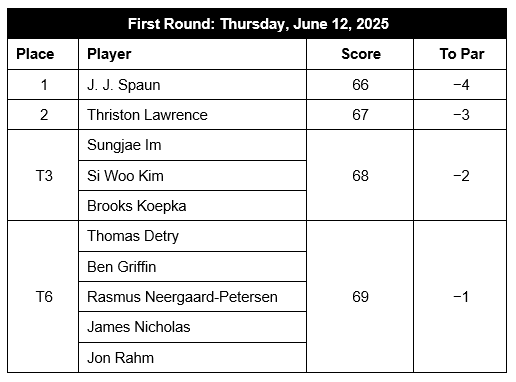
J. J. Spaun handled that challenge better than anyone on Thursday. According to ESPN and PGA Tour coverage, Spaun opened with a bogey-free 66. It was the only bogey-free round in the field and the best score of the day. He stayed patient, avoided the rough trouble that destroyed so many cards, and refused to give shots away.
Behind him, the leaderboard tightened quickly. Thriston Lawrence posted a 67 and stayed within one shot of the lead. Sungjae Im, Si Woo Kim, and Brooks Koepka finished at 68. Only ten players broke par.
By the end of the day, Oakmont had pushed the full-field scoring average to 74.63.
Golf Channel reported that it was the highest opening-round scoring average at a U.S. Open since Shinnecock Hills in 2018. The qualifiers who completed all four rounds averaged 71.9. Even the players who survived Oakmont were only marginally under control.
The scoring pattern reinforced the themes identified in the setup. Golf Monthly reported that Oakmont’s greens ran in the mid-to-upper 14s on the Stimpmeter during championship week. Severe slopes and difficult pin locations stretched first putts and forced players into defensive putting. Players still reached greens. They just were not finishing holes comfortably.
That pressure showed up throughout the leaderboard. Koepka stayed near the top through restraint and experience. He avoided the short-game mistakes that ruined otherwise solid rounds. Other contenders never completely lost control tee-to-green but slowly leaked shots away through poor angles, cautious lag putts, and difficult recoveries once approach shots missed ideal sections of the green.
Golf Digest later highlighted Oakmont’s unusually high number of three-putts compared to normal PGA Tour conditions. The opening round already hinted at that pattern. Oakmont’s pressure was not loud. It accumulated.
By Thursday evening, the championship already looked less like a modern scoring contest and more like a survival exercise. Under par existed, but only in small pockets. Every missed position carried consequences. Every par gained value. After one round, the leaderboard already reflected the core theme of the week. Oakmont was not defeating players by keeping them away from the green. It was defeating them after they got there.
The actual Round 1 Top Ten Leaderboard is provided below:
Replay Results
The replay at Steel City opened with a result that immediately validated the setup. The replay field averaged 71.9 in Round 1. That exactly matched the scoring average posted by the actual tournament qualifiers who completed all four rounds. The result added credibility to the replay setup using comparable weather (Calm), course conditions (Normal), and adjusted hole lengths with the Game Caddie’s “Modern” shot distances.
Players could still score, but they had to survive the accumulation of mistakes. The shape of the leaderboard also mirrored the actual championship. Only a small group finished at or under par. Pars carried value early, while under par remained difficult to reach and even harder to hold.
The replay Top Ten Leaderboard is shown below:
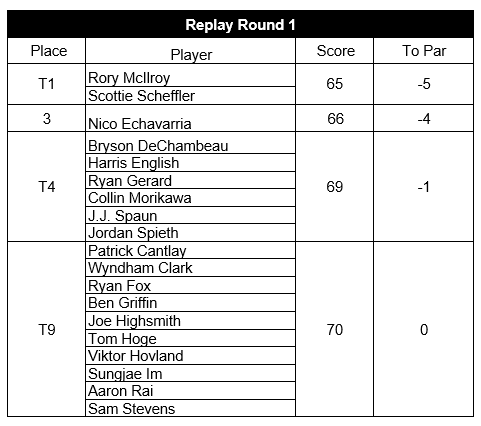
Three players jumped out front. Two were expected, while one was not. Rory McIlroy and Scottie Scheffler both opened at five under par. Their presence near the top was no surprise given their ability to separate from the field under major championship conditions.
Nico Echavarria was the surprise. Taking just 27 putts, a first-round low, he opened with a four-under 66 and stayed within one shot of the lead. Unlike McIlroy and Scheffler, he was not expected to dominate a U.S. Open setup built around survival and restraint.
Scottie Scheffler’s round looked exactly like the type of round Oakmont was designed to resist. Scheffler reached 16 greens in regulation while hitting 57 percent of his fairways. He avoided the compounding of mistakes that pushed so many other golfers’ rounds backward. His card contained only 29 putts and no bogeys.
The front nine established the round. Scheffler birdied Nos. 4, 5, and 6 to move to three under. He added birdies at Nos. 13 and 18 to close the round. Steel City gave him openings, and true-to-form he converted them.
The putting statistics reinforced the larger tournament theme. Scheffler reached five under despite making only 85.5 feet of putts. His longest made putt measured only 13 feet. The scoring came from position, approach control, and eliminating stress throughout the round.
McIlroy achieved the same score through a very different path. He hit only 43 percent of his fairways and needed several recoveries to maintain momentum. At the same time, he still reached 16 greens in regulation and racked up 166 feet of putts made. His longest conversion stretched to 42 feet.
The contrast between the two rounds mattered. Scheffler controlled Steel City, while McIlroy attacked it. Both approaches worked for one day. Whether both can survive four rounds remains the larger question.
Replay Round 1 Analysis
As noted, the setup for Round 1 matched that of the actual championship closely. The replay used Pin location 1 for all holes–the easiest of the four selected for this tournament. The course played to 7,410 yards. Hole yardages for the replay were adjusted to match the actual Oakmont setup when rounded to the nearest five yards.
The terrain notes for Steel City, all of which were adopted for the replay, make it an especially difficult course even under Calm weather conditions. Shots landing in regular rough roll no more than five yards and are played as buried lies with a 3-iron maximum club restriction. Fairway bunkers are automatic poor lies, while deep fairway bunkers limit players to a maximum 5-iron.
This setup created friction without shutting down scoring. Players could still advance the ball and reach greens. The challenge came after slight misses. Several holes forced awkward angles, rollback conditions, and uneven lies that slowly pushed players out of position.
The greens created the real pressure. Many holes included special putting instructions tied directly to pin position. Some first putts added one, two, or three columns to the putting result. Others doubled the remaining distance. Some holes added one or two columns to every putt. It may come as no surprise that the average number of putts was 31.4, nearly the same as the actual tournament qualifiers (31.0).
Replay Highlights and Lowlights
Round 1 at Steel City produced the same contradictions that defined the actual championship at Oakmont. Aaron Rai aced the 185-yard 13th. Joe Highsmith drove the green at the par-4 17th and made eagle. Russell Henley eagled No. 5, while Ryan Gerard eagled No. 14.
At the same time, the course punished even small mistakes with remarkable severity. Corey Conners four-putted from five feet on the 13th. Keegan Bradley needed five putts from ten feet on the same green. Sam Burns four-putted from 40 feet on the 18th, while Akshay Bhatia four-putted from 85 feet on the same hole.
Round 1 by the numbers:
• Scottie Scheffler and Rory McIlroy hit 16 of 18 greens in regulation. (Avg. = 11.5)
• Hideki Matsuyama hit the fewest greens at 7.
• Sungjae Im, Si Woo Kim, Maverick McNealy, and Jordan Spieth hit 10 of 14 fairways. (Avg. = 7.2)
• Min Woo Lee and Adam Scott hit the fewest fairways at 3.
• Harris English led all players in average driving distance (Nos. 7 and 15) at 348 yards. (Avg. = 300)
• Cameron Young led all players in average driving distance (all drives) at 316 yards. (Avg. = 293)
• Viktor Hovland had the longest drive. (395 yards)
• Ryan Fox and Collin Morikawa sunk the longest putts at 45 feet.
• Rory McIlroy had the longest total distance of putts made at 166 feet. (Avg. = 76.6)
• Nico Echavarria had the fewest putts at 27. (Avg. = 31.4)
• Chris Gotterup, Thorbjorn Olesen, and Rasmus Højgaard took the most putts at 36.
As the numbers show, contrast defined the opening replay round. Players still attacked par 5s, drove reachable holes, and produced moments of brilliance. At the same time, Steel City punished even small mistakes once players reached the greens. One shot could create momentum. One putt could destroy it.
Round 1 proved that the course did not need impossible scoring conditions to create pressure. Players still drove the ball long and reached greens at a reasonable rate. The damage came afterward. Long first putts, difficult putting position relative to the pin, and recovery attempts slowly accumulated across the field.
That pressure now moves into Round 2 with a more difficult Pin location (#4). The safe areas shrink and defensive putting becomes even more important. Steel City already proved it could punish mistakes quickly. Round 2 will test whether players can continue surviving them.
Complete statistical results for Round 1 of the replay can be viewed by clicking in the upper righthand corner of the PDF below: