This post compares the actual results from round 2 of the 2024 PGA Championship at Valhalla with those from my replay at Bluegrass. It also takes an in-depth look at why Xander Schauffele, winner of the actual tournament, is performing so poorly in the replay. Previous posts have detailed the replay setup and round 1 results.
Actual Results
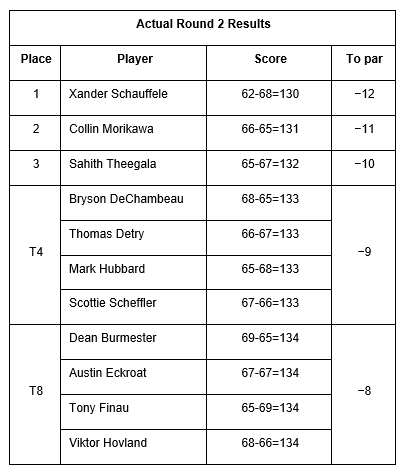
Round 2 at Valhalla was anything but routine, as steady rain, a lengthy weather delay, and one of the most surreal off-course moments in major championship history combined to produce a Friday that will be remembered long after the scores are forgotten. When play finally concluded late Saturday morning, Xander Schauffele remained atop the leaderboard, but the path there was far more chaotic than his historic opening act suggested.
After shooting a record-setting 62 on day one of the tournament, Schauffele followed it up with a solid, if comparatively subdued, 68 to reach 12-under par. While the round lacked the fireworks of Thursday, it was a composed, professional effort amid constant stoppages and changing conditions.
Fairways were heavy, greens receptive but unpredictable, and momentum hard to find as players were repeatedly pulled off the course during a significant weather delay that stretched the second round across two days. Schauffele’s ability to stay patient and limit mistakes allowed him to preserve a narrow lead heading into the weekend.
The chase tightened considerably behind him. Collin Morikawa quietly pieced together one of the best rounds of the championship, firing a crisp 65 to climb into solo second place at 11-under. Morikawa’s elite iron play was on full display, as he repeatedly attacked pins in conditions that rewarded precision, not power. Just one stroke further back, Sahith Theegala continued his steady ascent, adding a 67 to his opening 65 to sit third at 10-under, once again showcasing the creativity and resilience that have made him a rising force on the biggest stages.
A crowded group at 9-under par underscored how compressed the leaderboard became. Bryson DeChambeau muscled his way into contention with a bogey-free 65, while Thomas Detry and Mark Hubbard remained firmly in the mix with solid, workmanlike rounds.
Scottie Scheffler’s name also appeared in that cluster, though his week took a stunning detour away from the golf course. Early Friday morning, Scheffler was briefly detained and arrested following a traffic incident near Valhalla’s entrance amid police activity related to the weather-delayed schedule. The incident sent shockwaves through the golf world, but Scheffler responded with remarkable composure, returning to shoot a 66 and remain well within striking distance of the lead.
At 8-under, Tony Finau, Viktor Hovland, Dean Burmester, and Austin Eckroat lurked just outside the top tier, all still very much alive as the championship turned toward the weekend. With Valhalla playing long but scorable thanks to rain-softened defenses, round 2 transformed the 2024 PGA Championship from a Schauffele showcase into a wide-open major—one shaped as much by resilience and adaptability as by birdies.
The top of the actual round 2 leaderboard is shown below:
Replay Results
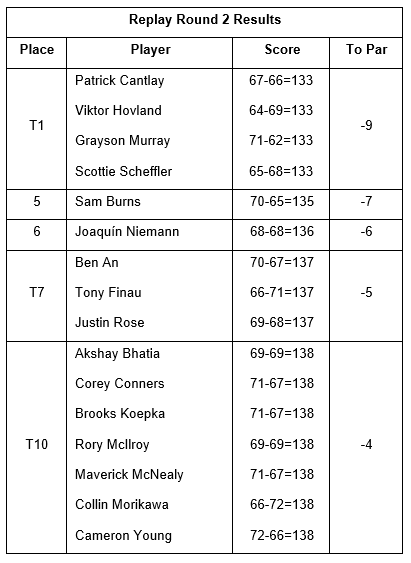
Round 2 at Bluegrass delivered a jolt of energy to the championship, reshaping the leaderboard, and tightening the competition with four players tied for the lead at 9-under par.
Grayson Murray authored a stunning turnaround, erupting for a brilliant 9-under 62 that erased a grinding opening 71 and launched him into a share of the lead. Murray was aggressive from the start and never let up, posting 31 on each nine and attacking flags with confidence. He hit 13 of 18 greens in regulation, and when he did miss, his recovery work kept momentum firmly on his side.
The defining moment came at the par-5 10th, where Murray poured in an eagle to ignite a scoring run that transformed his round into a full-scale charge. With just 23 putts on the day Murray converted repeatedly from inside 15 feet, upping the pressure on the field.
Patrick Cantlay continued his methodical march with another efficient round, backing up his opening 67 with a steady 66 to reach 9-under. Cantlay’s round was built on patience and control, avoiding mistakes and capitalizing when opportunities appeared. This is a familiar formula that once again proved effective on a course rewarding discipline.
Viktor Hovland, the first-round leader, held onto a share of the top spot despite cooling slightly. His 2-under 69 on day two lacked the fireworks of Thursday’s back-nine blitz and 7-under finish, but he remained composed and resilient. His reliable ball-striking helped him navigate a tougher second-day setup.
Scottie Scheffler rounded out the quartet at 9-under with a solid 68. Scheffler’s game was anchored in precision rather than power. He plotted his way around Bluegrass and kept stress off the card, even as birdie chances proved hard to convert.
Just one tier back, Sam Burns climbed into fifth at 7-under after a sharp 65, while Joaquín Niemann’s steady play left him at 6-under. A tightly packed group at 5-under, including Tony Finau, Justin Rose, and Ben An, are still very much in the hunt.
After two rounds Bluegrass has proven it will reward bold play without forgiving lapses. Murray’s electric 62 reset the replay championship narrative by showing that big swings in scoring are entirely possible. With four proven contenders leading the way and another dozen within five strokes, the weekend promises a battle where momentum may shift as quickly as it did in round 1.
The replay top-ten leaderboard is provided below:
If the replay’s round 1 suggested Bluegrass could be scored on with discipline, round 2 confirmed that red numbers are achievable—though not at the historic pace seen in the actual event. Birdies required commitment and clean execution, and while scoring conditions were favorable, they still demanded precision to fully capitalize. The result was a leaderboard that tightened steadily rather than splintered, with low rounds rewarded but not handed out freely.
That balance defined the second round. Par 5’s continued to offer the clearest scoring chances, but players still had to earn their opportunities through positioning and touch. Eagles shifted momentum, efficient putting separated contenders from the pack, and mistakes—even minor ones—carried weight in a field where steady under-par golf, rather than record-breaking numbers, set the pace.
Here’s a look at some of the standout notes and superlatives from the opening round, illustrating how Bluegrass played and where players found their advantages—and pitfalls:
- Nick Taylor, Tom Kim, and Joaquin Niemann eagled No. 18 – a 570-yard Par 5.
- Xander Schauffele and Grayson Murray eagled No. 10 – a 590-yard Par 5.
- Matthew Fitzpatrick hit 15 of 18 greens in regulation. (Avg. = 10.8)
- Christiaan Bezuidenhout hit the fewest greens at 4.
- Six players hit 12 of 14 fairways. (Avg. = 8.5)
- Sepp Straka hit the fewest fairways at 6.
- Kurt Kitayama led all players in average driving distance (two holes) at 352 yards. (Avg. = 298)
- Taylor Pendrith led all players in average driving distance (all drives) at 309 yards. (Avg. = 290)
- Rory McIlroy had the longest drive at 385 yards.
- Rasmus Hojgaard sunk the longest putts at 62 feet.
- Bryson DeChambeau had the longest total distance of putts made at 122 feet. (Avg. = 82.6)
- Brian Harman and Grayson Murray had the fewest putts at 23. (Avg. = 27.8)
- Victor Perez took the most putts at 33.
What’s Up with Xander Schauffele?
After two rounds Xander Schauffele—the actual tournament winner at 21-under par—sits at 5-over par, tied for 73rd in the replay. Setting aside bad luck, dice rolls, or decision-making, much of the discrepancy appears to be structural. Scoring with Schauffele using his 2024 card has consistently felt off, prompting a closer examination of his ratings.
Schauffele is rated W-4 / I-3, with the anomaly clearly centered on the I-3 rating. Based on my prior analysis of APBA player cards, most exhibit a relatively balanced Play Result Number (PRN) outcome distribution around their rating value—commonly 7-7-7, 6-6-6, or more typically 6-8-6. With an I-3 rating, we would expect something close to 6-2s / 8-3s / 6-4s in the I-column.
While some variation exists, it is rare to find a player whose average Iron or Wood results fall materially below both the rated value and the adjacent outcomes. Schauffele is a notable exception, with an Iron distribution of 8-2s / 4-3s / 10-4s. From a mid-iron, birdie-hunting perspective, this distinction is meaningful.
In standard situations—where aiming is allowed and roll is not a factor—the optimal safe play from the fairway with a 3-rated iron is to target one square left of the pin. A PRN of 2 or 4 leaves the ball one square away, and a PRN of 3, due to the averaging rule, produces the same result. In these cases, Schauffele’s card behaves no differently than others, and conventional strategy applies.
The divergence emerges on aggressive approaches, when the intent is to attack the hole. For most players, the average Iron result places the ball on the cup, creating a strong one-putt opportunity, while the other outcomes finish one diagonal away and more often result in two putts. On Schauffele’s card, that favorable average outcome is effectively absent, making aggressive iron play significantly less rewarding.
Strategically, this leads Schauffele to play slightly short more often than long, while also reaching his true average distance less frequently. As a result, both front- and back-pin placements—of which Bluegrass offers many—become inherently riskier, particularly when aggressive iron play is required.
Why Schauffele’s card is constructed this way is open to speculation. What is clear is that this characteristic must be accounted for as the replay progresses.
Impressions:
After 36 holes, the replay results have made one thing clear: Bluegrass is rewarding length and accuracy in equal measure. Players who can combine controlled power off the tee with solid iron play have found the most consistent scoring opportunities, particularly on the longer par 4’s and reachable par 5’s. That said, the door hasn’t been closed to everyone else. A handful of shorter hitters have navigated the course successfully through positioning, patience, and sharp putting–proving there is more than one way to contend.
At 7,610 yards and playing to a par 71, Bluegrass is a legitimate major championship test. Scoring is available, but it must be earned, and separation has been modest through two rounds. With the leaderboard still tightly packed, round 3 sets up as a pivotal moving day. Disciplined aggression and sustained execution will determine who carries momentum forward as the tournament continues to take shape.
Complete statistical results for round 2 of the replay can be viewed by clicking in the upper righthand corner of the PDF below: