This post is the first in a series describing my replay of the 2024 PGA Championship at Valhalla Golf Club, also known as Bluegrass by APBA fans. The series begins with an in-depth look at the tournament setup and will continue with detailed round-by-round recaps. Using Game Caddie 7.0 in “Modern” Master Game Player Mode with distance settings specifically calibrated to better reflect today’s players’ shot distances, the replay aims to provide a highly realistic simulation from tee to cup.
Overview of the Actual Event
Valhalla Golf Club is one of golf’s true heavyweight venues. Designed by Jack Nicklaus and built to instill championship pressure, the Louisville layout has hosted some of the sport’s most dramatic moments. Prior to 2024, Valhalla’s most recent major outing came in 2014—when the PGA Championship last rolled through—making the 2024 Championship a long-awaited homecoming.
On paper, Valhalla looked to be a formidable test. Stretching to 7,609 yards at par 71, with more than 60 bunkers and two streams cutting through the property, the course demanded accuracy and length from every player. Key holes pushed deep into the layout, setting up high-risk/high-reward decisions.
Yet in practice, the course played easier than projected. Fairways were more accessible, approaches to the greens played better than the Tour average, and the putting surfaces—smaller than average at 5,000 square feet—were actually easier than the typical Tour event, helping the field post lower scores than expected.
The scoring revealed just how tight the field was. Of 158 starters, 78 made the cut at –1. With round-by-round averages of 71.2, 71.1, 69.6, and 69.3, most players, whether they qualified or missed the cut, finished just a few strokes apart. The qualifiers’ consistent performances throughout all four rounds with finishes several strokes above the cut line, demonstrate that success at Valhalla was determined by reliable execution rather than dramatic shots, which reflects the event’s depth and competitiveness.
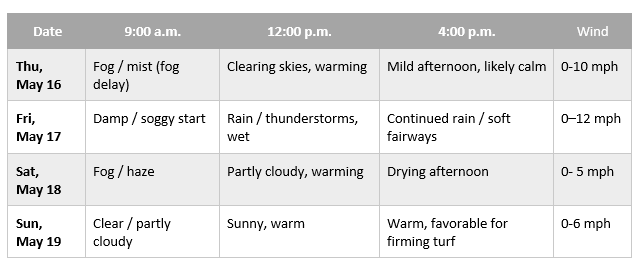
Heavy rain before and during the tournament softened fairways and greens, making the course more receptive than originally designed. Soft turf offset the cost of errant drives and allowed approach shots to hold the greens more easily. Calm winds also helped keep scores down throughout the event.
Below is a simple snapshot of conditions at 9 a.m., noon, and 4 p.m. each day of the tournament, based on official reports and weather-station data:
Replay Setup
The purpose of setting up the replay to match the conditions and scoring of the actual tournament is threefold.
- It aims to replicate the playing environment of Valhalla as closely as possible, including driving distances, green approaches, and putting difficulty, so that performance in the replay reflects realistic outcomes.
- It provides a controlled platform to test player strategies and decision-making, allowing observation of how different styles (length off the tee, accuracy, approach precision, and putting) interact with course design.
- It seeks to examine whether the balance observed in the actual tournament—where small skill differences separated the leaders and multiple playing styles succeeded—holds true under similar layouts and conditions, in this case at Bluegrass.
Weather: Given the relative lack of wind across the four days, the replay will be played with “Calm” winds each round.
Replay Field: APBA’s 2024 Men’s card set includes 69 players who competed in the tournament, while the game itself features 80 players in total. Since the actual cut line was 78, all 69 carded players will automatically advance to the weekend.
Driving: The PGA Tour reported statistics only for tournament qualifiers (i.e., the players who completed all four rounds). These qualifiers averaged 300 yards on two-drives and 290 yards on all drives, nearly identical to the 2024 Tour averages of 300.2 and 292.8 yards, respectively. Rain on a few days had minimal impact, leaving driving distances close to typical PGA Tour values. Accordingly, the replay will use the men’s “Modern” shot boards and Normal course conditions without any fairway or green roll adjustments.
Putting: Qualifiers averaged 28.3 putts per round, slightly below the 2024 Tour average of 29.1, indicating that this major played somewhat easier than typical events. This replay will therefore use Regular putting boards and the easiest pin placements, based on an algorithm validated across previous replay tournaments.
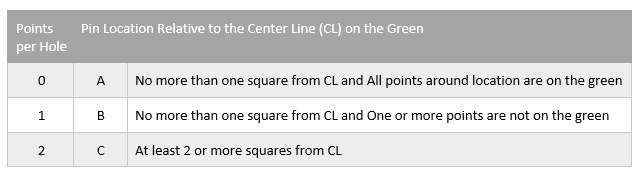
Course Setup: Pin placements for the replay were determined using a difficulty-based algorithm that rates each location relative to the center line (CL) of the green. Each hole received a score from 0 to 2 points based on the criteria shown in the table below:
Using this system, the total difficulty scores across 18 holes were calculated as shown in the table below:

Pins 5 and 6 are the easiest (TDS=21), leaving Pins 1–3 (TDS=27) for the remaining two selections. Of these, Pin 3 has the fewest back-of-the-green placements, while the choice between Pins 1 and 2 is essentially a coin flip, with Pin 2 selected. The pin locations used in the replay therefore will be 2, 3, 5, and 6, reflecting the easiest achievable setup while maintaining realistic variability across the course.
Hole Adjustments: Since no day-by-day summary of hole distances is available, the replay will use a constant course length of 7,610 yards for every round. This also accounts for length variations associated with different pin locations. The table below shows the manual hole length adjustments that will be made for each pin used at Bluegrass to better match those for the actual 2024 PGA Championship:
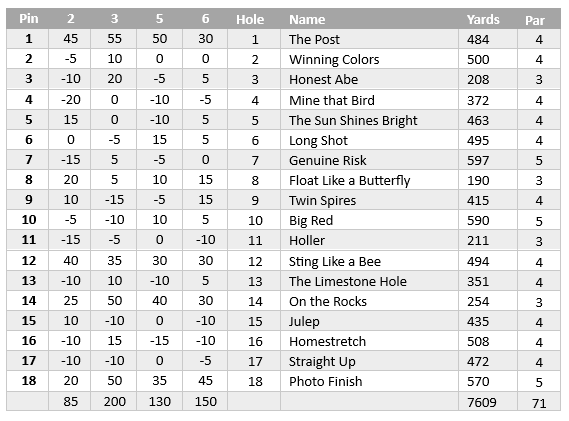
As you can see, hole lengths will be anywhere from 55 yards longer to 20 yards shorter. For each round, the course length will range from 85 to 200 yards longer compared to Bluegrass’s normal course distances for those pin placements.
Summary
The replay setup for Bluegrass is designed to closely match the actual tournament statistics, capturing the balance between distance, accuracy, and putting difficulty observed at Valhalla. While the numbers provide a solid foundation, the true test always lies in how players navigate the course—because, ultimately, that’s why we play the game.
Looking at the top five finishers in the actual tournament—Xander Schauffele (-21), Bryson DeChambeau (-20), Viktor Hovland (-18), Thomas Detry (-15), and Collin Morikawa (-15)—it appears that a diverse array of playing styles can succeed at Valhalla. DeChambeau leveraged his exceptional length off the tee to shorten holes and attack pins, while Morikawa relied on remarkable accuracy and precise iron play. Schauffele and Hovland consistently hit greens in regulation, showcasing versatile shot-making, while DeChambeau and Detry leaned on strong putting to gain strokes on the field.
If Valhalla can be mastered by different playing styles–with only small margins separating the leaders–it will be interesting to see whether that same holds true for the replay using a similar layout and playing conditions.
The next post in the series will present a comparison of Round 1 results for the actual tournament and the replay once completed.