This post compares the final round of my 2024 PGA Championship replay with the actual event. I also provide an analysis of how realistic the replay tournament results were using the current version of the Game Caddie (7.X). See the write-ups of rounds 1, 2, and 3 for additional context.
Round 4 Actual Results: Sunday Builds To A Final-Hole Showdown
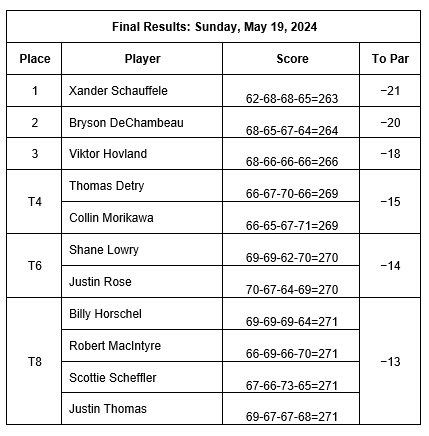
Sunday at Valhalla unfolded under calm, sunlit conditions that encouraged aggressive play from the start. With Collin Morikawa and Xander Schauffele beginning the day tied at the top, the final round quickly became a race to establish early momentum. Schauffele wasted little time doing exactly that, producing timely birdies on the front nine that allowed him to maintain control of the championship even as Bryson DeChambeau and Viktor Hovland tried to close the gap.
Benefiting from receptive playing conditions and scoring opportunities on Valhalla’s par 5s, DeChambeau pieced together an aggressive round that ultimately produced a brilliant 64. Hovland, meanwhile, continued the steady ball‑striking that had defined his week, looming just off the lead throughout the afternoon. Yet neither player was able to generate the early surge needed to overtake Schauffele, who consistently answered pressure with composed scoring and mistake‑free golf.
The championship ultimately turned on the closing stretch. As DeChambeau completed his charge, Schauffele still had the decisive opportunity in front of him at the par 5 18th. Demonstrating the composure that had characterized his entire week, Schauffele laid up from an awkward lie, wedged his approach close, and confidently sank a birdie putt to secure the Wanamaker Trophy. His final‑round 65 completed a remarkable performance — four rounds in the 60s and a winning total of 21‑under par, one of the lowest scores in major championship history.
Here is the top of the leaderboard for the actual tournament:
Round 4 Replay Results: Moving-Day Separation Decides The Championship
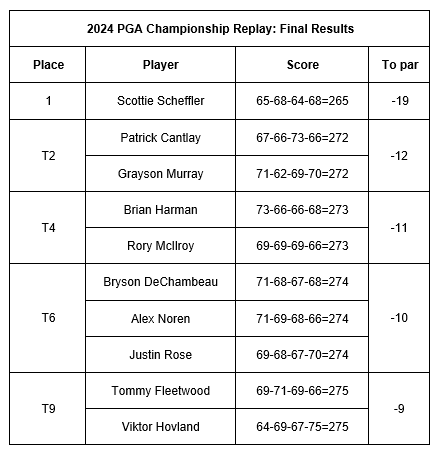
Unlike the actual championship at Valhalla, where moving day compressed the leaderboard, the replay at Bluegrass produced the opposite effect. Scottie Scheffler’s brilliant third-round 64 created the first real separation of the tournament, pushing him to 16-under and giving him a three-shot cushion over Viktor Hovland entering the final round. Behind them, the field remained tightly grouped, but the dynamic had shifted from a crowded Sunday shootout to a pursuit of the leader.
Scheffler’s advantage proved decisive on Sunday. Rather than needing a dramatic closing charge, he relied on the same steady formula that had carried him all week — disciplined driving, consistent iron play, and efficient putting. His final-round 68 (-3) was not spectacular, but it was more than enough to maintain control of the championship as the challengers struggled to generate sustained momentum.
Patrick Cantlay and Grayson Murray mounted the strongest late pushes, both posting rounds that lifted them into a tie for second at 12-under. Brian Harman and Rory McIlroy followed at 11-under after steady closing rounds, while Bryson DeChambeau, Alex Noren, and Justin Rose finished just behind them. The most dramatic shift came from Hovland, who began the day as the closest contender. But he fell back after a rough closing round 75 (+4), effectively removing the final obstacle between Scheffler and victory.
In the end, Scheffler’s four-round total of 19-under par delivered a commanding seven-shot victory, the largest margin of the replay. Where the real championship came down to a final-hole birdie, the Bluegrass replay instead showcased the power of a dominant moving day. Once Scheffler created separation on Saturday, the rest of the field spent Sunday chasing a lead that ultimately proved unreachable.
The top-ten leaderboard for the replay is provided below:
The replay’s championship Sunday at Bluegrass produced the same balance that defined much of the tournament: scoring opportunities were available, but only to players who combined precise ball-striking with confident putting. With the leaderboard already shaped by Scottie Scheffler’s dominant moving-day performance, the final round shifted the pressure squarely onto the field. Players looking to mount a charge needed to attack the par 5s, while avoiding the subtle mistakes that could quickly stall momentum.
The numbers from the final round reinforce that theme. Eagles on the reachable par 5s provided the most explosive scoring opportunities, while accuracy off the tee and disciplined iron play remained essential for sustaining a low round. At the same time, the putting surfaces once again played a decisive role, rewarding confident strokes and punishing hesitation.
Round 4 Replay: Highs and Lows
What follows is a snapshot of the round’s defining moments and statistical extremes, highlighting where Bluegrass gave, where it resisted, and how the field navigated that balance:
- Doug Ghim and Patrick Cantlay eagled No. 7 – a 595-yard Par 5.
- Xander Schauffle, Collin Moikawa, Tony Finau, Alex Noren eagled No. 18 – a 570-yard par 5.
- Jon Rahm hit 16 of 18 greens in regulation. (Avg. = 11.2)
- Tom Hoge hit the fewest greens at 6.
- Brice Garnett hit 13 of 14 fairways. (Avg. = 8.4)
- Robert MacIntyre and Sungjae Im hit the fewest fairways at 4.
- Tyrrell Hatton led all players in average driving distance (two holes) at 348 yards. (Avg. = 301)
- Rasmus Højgaard led all players in average driving distance (all drives) at 305 yards. (Avg. = 289)
- Keegan Bradley, Sahith Theegala, and Will Zalatoris had the longest drives at 385 yards.
- Kurt Kitayama sunk the longest putts at 58 feet.
- Shane Lowry had the longest total distance of putts made at 148 feet. (Avg. = 82.5)
- Xander Schauffele had the fewest putts at 22. (Avg. = 28.6)
- Stephan Jäger and Brice Garnett took the most putts at 35.
Actual vs. Replay: A Statistical Comparison
While the storylines of the two tournaments diverged — one decided on the final hole and the other shaped by a dominant moving day — the underlying performance patterns tell a more nuanced story. Beneath the surface drama, both the actual championship at Valhalla and the Bluegrass replay were driven by many of the same competitive fundamentals: driving distance, approach accuracy, and putting efficiency.
A closer look at the numbers shows that the replay reproduced many of the statistical characteristics of the real event. Scoring levels remained comparable, driving distance aligned almost perfectly, and putting performance tracked closely across both events. Differences did appear in areas such as fairways hit, greens in regulation, and sand saves — small variations that reflect the natural variability of tournament golf rather than a fundamental shift in how the course played.
The comparison below summarizes several key performance indicators for players who completed all four rounds. Taken together, these measures provide a useful lens for evaluating how closely the replay environment mirrored the statistical profile of the actual championship — and help frame the broader assessment of how the Game Caddie models modern tournament golf.
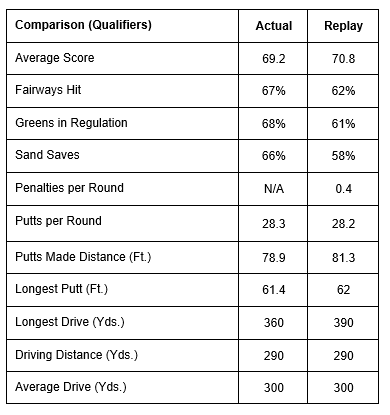
The statistical comparison provides useful context for interpreting the replay results. While both groups produced scoring averages under par, the real tournament field performed slightly better overall, posting an average score of 69.2 compared with 70.8 in the replay. The most noticeable differences appear in fairways hit and greens in regulation, where the replay field trailed the actual tournament by several percentage points.
Much of that gap can be traced to how Bluegrass interacts with the Game Caddie ruleset. Nearly every hole on the course is bordered by deep rough, which in the game limits recovery shots to a maximum of a pitching wedge. On longer holes, that restriction often prevents players from reaching the green in regulation after missing the fairway. Many holes are also lined with trees that partially block approach shots played from just off the fairway, further complicating recovery attempts. On a stretched layout such as Bluegrass — played at 7,610 yards for this replay — the impact of those hardships accumulate quickly.
Conditions at the actual championship appear to have been less severe. Contemporary reports described Valhalla’s rough at roughly four inches. But many observers noted that balls frequently sat up in the grass, allowing players to advance the ball more aggressively than expected. In addition, rain throughout the week softened the course and made approaches easier to hold, offsetting the cost of missed fairways.
By contrast, the metrics for driving distance and putting aligned almost perfectly between the two events. Average and total driving distances matched closely, validating the use of the Game Caddie’s “Modern” Distance Settings for the replay.
Putting performance was equally consistent, with nearly identical averages for putts per round and total distance of putts made. The replay’s pin placement and putting setup were specifically designed to replicate realistic scoring conditions, as described earlier in the setup section.
Penalties were tracked in the replay at an average of 0.4 per round, though exact figures were not reported in PGA Championship statistics. Even so, anecdotal reports do not point to a high volume of penalty strokes among the field, including qualifiers, unlike typical PGA Tour water-strewn events.
Taken together, the results suggest that the Bluegrass replay captured many of the essential dynamics of the actual championship. Scoring levels, driving distance, and putting performance aligned closely with the real event, while differences in fairways and greens reflect how course architecture and APBA’s treatment of deep rough for Bluegrass influenced recovery shots throughout the week.
The paths to victory ultimately diverged — one championship decided on the final hole and the other shaped by a dominant moving day — but both outcomes fall comfortably within the range of how major tournaments unfold. In the actual event, Xander Schauffele’s closing birdie on the 72nd hole secured a dramatic one-shot victory. In the replay, Scottie Scheffler’s third-round surge created separation that the field could not overcome.
In that sense, my Bluegrass experiment achieved its primary objective. While the precise storyline differed, the underlying statistical profile and competitive dynamics remained remarkably consistent with the real championship. When course setup, player ratings, and tournament conditions are carefully aligned, APBA golf played with Game Caddie proves capable of producing results that closely resemble the balance and unpredictability of modern professional golf. If the goal of a replay is to capture how a major championship unfolds, this replay comes impressively close.
The entire set of tournament replay results can be viewed by clicking the upper righthand corner of the PDF below: